
Section IV: Results
Leesi starts to separate himself from his parents’ expectations and choices, unpacking the trauma that was passed down to him and finding his own identity.
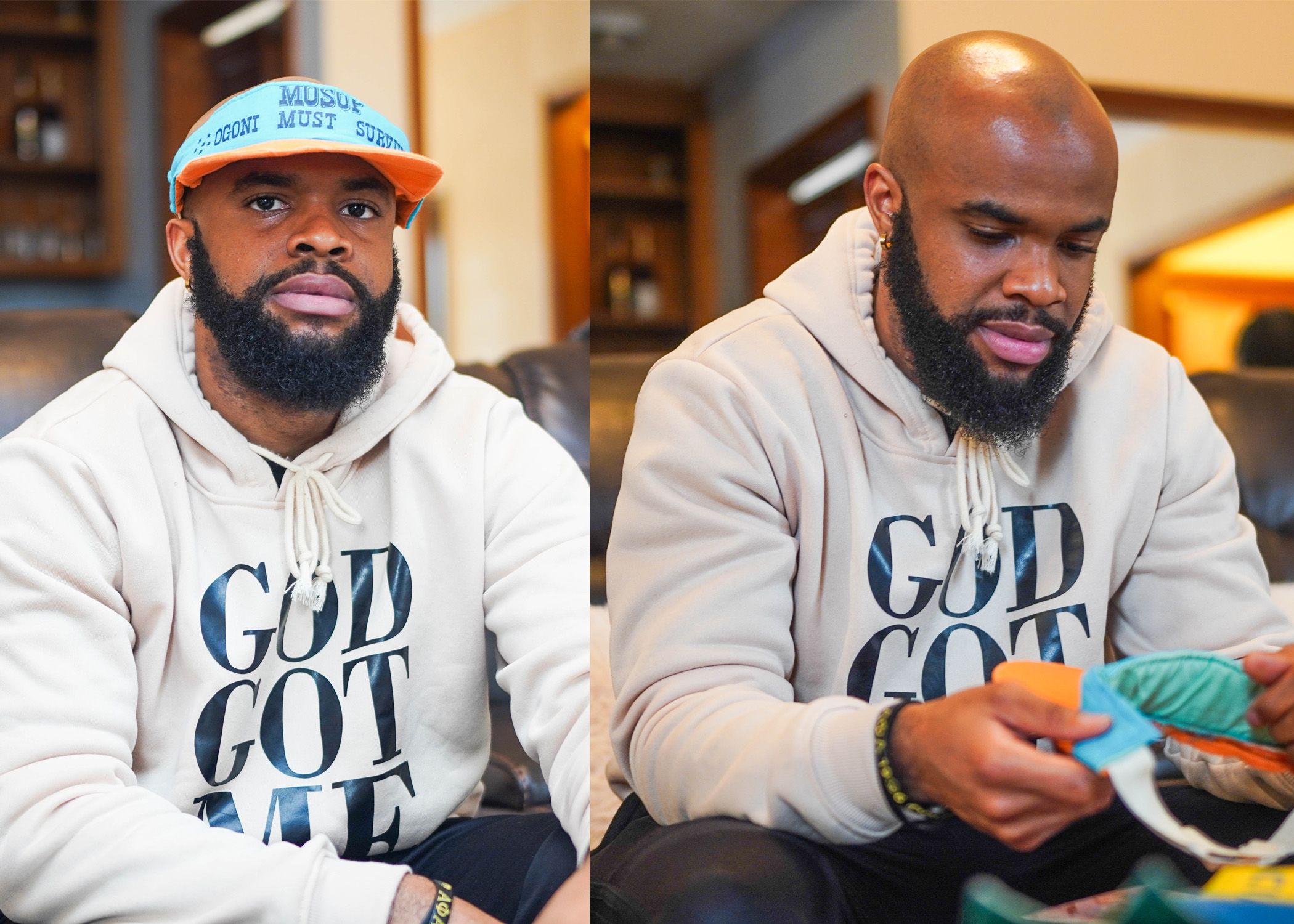

A different (academic) path
Several years earlier, during the summer between Leesi’s junior and senior year, Leesi attended the Accelerated Business Program, a prestigious weeklong offering at the University of Georgia (UGA) Terry College of Business featuring guest lectures from corporate executives and an insight into college life.
Leesi didn’t have much interest in business as a career, but he liked the UGA campus and culture. It felt more approachable to him than the “Ivy League of the South,” as Emory was known. And it was far enough from home that he could set aside some of the burdens of being the oldest son and only worry about himself for a while.
He knew he’d be able to secure a Zell Miller Scholarship, a Georgia initiative that awarded students who earned at least a 3.7 GPA in high school (and met a few other requirements) a full-tuition scholarship at state schools, including UGA.
But the scholarship didn’t cover room and board, textbooks, or incidentals, so he’d have to ask his parents if they could help with that element of financial support. And they had always expected him to go to Emory, an institution whose reputation had stretched all the way to Nigeria as a way to build connections and move up in the world.
Leesi and his parents had scheduled a meeting to discuss the fraught topic.
I have to make my decision, Leesi told Monica and George. I want to go to UGA. I don't want to go to Emory.
Why would you do that? George and Monica asked. Your tuition at Emory is free because your mother works there.
Leesi told his parents about the Zell Scholarship and showed them an Excel spreadsheet in which he’d calculated how much each year at Emory and UGA would cost as a result. In total, UGA would cost $50 less than Emory.
Monica and George scoffed.
The University of Georgia is too big for you, they said. You’ll just get lost. And they drink there. People say it’s a party school. And it’s so far away. Emory's right here. You don't have to stay on campus; you can live at home.
I don't want to do that, Leesi told his parents.
They talked into the night.
“It’s probably one of the few times that I saw him cry,” Tombari says. “There was pressure from my parents, who wanted him to go to the best school that would give him the best opportunity to have the best career and forge the best path. Seeing him struggle between what is the best — what my parents think is the best versus what he felt was the best for himself — was really hard.”
But Leesi knew he wasn’t going to compromise.
“I think that was my first time feeling like I got to fight for something,” Leesi says. “Because I actually had the power to make the decision. They could tell me they weren’t going to help pay for it, but I knew I could make it work. Nobody could really tell me not to go.”

When depression hits
And so Leesi went to UGA, working in food service and later as an office assistant in a mailroom on campus to pay for expenses that weren’t covered by his scholarship. Though his parents eventually came around and covered Leesi’s necessities, he still felt like he needed to work so his parents weren’t burdened with too much debt.
Outside of work and classes, he joined an organization called Fight Against Youth Obesity (FAYO). Pulling from his experience programming archery activities for kids at a Jewish community center, he developed physical activities for kids to do every Friday for an hour and a half.
“Physical activity is something I like to do, and kids love to do,” Leesi says. “I knew it made me feel good and made kids feel good. I always wanted to be a positive light for them.”
Soon, though, he was struggling to feel positive anywhere. Even though Leesi became the president of FAYO and a brother in the prestigious African-American Greek organization Alpha Phi Alpha Fraternity, Inc., he felt like everything was happening from a distance.
“I would try to get back to myself and figure out how to be happy in those moments when you’re sitting on a futon with people who are your friends, but I wasn’t able to channel any emotion outside of a heavy weight and frustration,” Leesi says.
He started dropping his friends off at parties but didn’t join them, wallowing in self-pity in secret.
“I knew it was going to happen,” he says. “No matter what the day looks like, you know how you’re going to feel when the night ends.”
Before Leesi knew it, he was graduating from UGA with a bachelor’s degree in exercise and sports science. He moved back in with his parents — who now owned UGA T-shirts after a several-year boycott — and took a gap year to prepare for the MCAT.
“As a Nigerian, you only have three career options: physician, engineer, or lawyer,” Leesi says, chuckling.
At the end of the summer, Leesi returned to his fraternity brothers’ house at UGA to help with the first party of the year. It was a tradition for recent grads to come back. Vibes were flowing, and being back with his brothers gave Leesi permission to leave behind his anxious thoughts for a while.
Once the music had faded and he’d dropped off all his friends who still lived in Athens, he was faced with an hour and a half drive back to Stone Mountain, alone.
That’s when the realization of life hit him. The depression he’d been using the party and the weekend with his brothers to avoid crashed into his consciousness.
“I couldn’t see past graduation,” Leesi says. “I’d been working toward that for so long. Now that I’d graduated, I was supposed to have a life afterward, and I didn’t know what that was going to look like. I had to live this life that I never gave a fuck about before.”
I don’t want to be here anymore, he thought.
He let go of the steering wheel.
The car drifted across the road, slowly, as if in anticipation. (“If you’ve seen the season three finale of “BoJack Horseman,” it was like that,” Leesi says.)
Then Leesi felt a hand on his shoulder. No one was there, but he got the subliminal message: He needed to grab the wheel and pull over.
In that moment, he felt selfish and guilty. He didn’t want to take anybody else’s life because of his own recklessness.
I couldn’t believe that I almost did that to somebody, he thought.
And then, the scarier thought: I couldn’t believe I would want to do this to myself.
In western Africa, suicide — the act of killing yourself because of depression — is associated with something that's not godly. That’s evil, some Nigerians would say. That’s demonic. That’s voodoo.
This taboo element makes it difficult to openly, or even privately, discuss mental health in many communities. If there’s a problem with your brain, the assumption is that God, not your community, will help you solve it.
“While I think religion is an incredible force, I also think that coming from the society that I do, God sometimes becomes your crutch when you’re having to fight against stressors,” Leesi says. “You run straight to the Lord anytime issues occur. Which is powerful and important but may obscure the fact that these can also be psychological mental health issues.”
“The Lord may be able to place these people in your lives who are able to help — doctors and psychiatrists and psychologists,” he continues. “But it becomes difficult to see how you can change how you perceive and handle stress. For me, that’s layered within being a refugee, being Ogoni, being a Nigerian. I had to deconstruct those layers.”
In the past, when doctors asked him if he was depressed, Leesi had simply lied. Now, though, he sought professional help.
Day by day, he pulled himself out of the dark corners of his mind. He knew he wanted to be around for his family. But through therapy, he realized he also needed to live for himself.


A career pivot
In the fall, Leesi worked as a tech for an ophthalmology clinic in Atlanta. He wanted to specialize in orthopedic surgery or sports medicine long-term but figured he could gain from any experience in a medical setting.
Yet the clinic opened his eyes to the reality of American healthcare. It served neighborhoods that were primarily home to minority and/or low-income Atlantans, and the endless bureaucracy and inanities of insurance frequently kept these patients from getting the help they needed.
Leesi thought he could be a good doctor. But given the time and money to become one, coupled with the systemic problems that built up barriers to care, he realized he wouldn’t be able to have the immediate impact he’d been hoping for.
This is the community that I want to help, Leesi remembers thinking. So if, as a physician, I’m going to have to battle more people that don't want to help this community, how else can I help? How can I make things easier for patients without being a doctor?
On a whim, he applied to a UGA master’s program in kinesiology so he could continue learning as he figured out a new career.
As a graduate teaching assistant, Leesi designed and taught sport courses to UGA undergrads, including “Beginner Volleyball,” “Beginner Tennis,” “Ultimate Frisbee,” and “Introduction to Weight Training.”
“He saw that he loved teaching,” Monica says.
“I like seeing people grow and the happiness they have in putting effort into something and seeing tangible results,” Leesi says. “It’s different when it comes to academics; you have to do well there. But when it comes to any type of sports activity or physical thing, you can add your own self to the process.”
When Leesi spoke with his advisor, clinical associate professor Chris Mojock, about the future, Mojock broached the possibility of a PhD. He pointed to Leesi’s work as a research assistant for Mojock’s doctoral student during undergrad, when Leesi ran a 10-week exercise class for older adults.
If you care about education and teaching, if you care about research and you enjoy creating a program to help people, this could be an option, he said.
Leesi was open to the idea. He hadn’t realized a PhD was even a possibility before. But the prospect of becoming a doctor (without having to pay the loans required to become a medical doctor) was appealing.
Mojock had heard through mutual contacts that University of Michigan movement science professor Leah Robinson was looking for doctoral students in her Child Movement, Activity & Developmental Health Laboratory.
The process went quickly from there, so much so that Leesi was still trying to figure out what unique elements he could add to the research around motor development by the time he was accepted at U-M. But he was interested in exploring a new place, outside of Georgia and his own bubble.
And he had received a Rackham Merit Fellowship, which would give him an extra year of funding and allow him the time to get acclimated to the life of a doctoral student without having to teach during his first year.
Plus, he was accepted to a NIH-funded summer research program through U-M. The latter program teaches early-career graduate students how to do research properly and pairs them with faculty mentors who are funded by NIH so they have opportunities to see how a high-level research project operates and contribute to the final product.
“I knew I’d be able to gain the necessary knowledge and the proper support to feel confident in getting a PhD,” Leesi says. “Mentorship, support, and money — that’s what tipped the scales for me. The money, man…I realized I didn’t have to go broke for this.”


Putting it all out there
“Anxiety. It is defined as an emotion characterized by feelings of tension, worried thoughts, and physical changes, like increased blood pressure and shortness of breath.
“Now, feelings of anxiety are normal, and we’ve all experienced them at one time or another, be it during your first test or competition or maybe you’re anxious walking down a dark hallway or walking into a room of your peers. Or… maybe you’re anxious at home giving your first King talk.
“Yeah, those feelings are bound to come and go. They’re temporary. But imagine if those feelings during those temporary moments weren’t so temporary. Imagine that they grew into a consistent worry and fear, becoming an ongoing and underlying part of your life.”
These words made up the first minute of Leesi’s Rackham King Talk in January 2022. U-M’s Rackham Graduate School, which partners with units on campus to run the university’s master’s and PhD programs, holds these talks every year as part of its Martin Luther King Jr. (MLK) Day events. Graduate students discuss how their work relates to MLK’s legacy in a TED-talk style.
Dressed in a navy blue button-down with a shadowy image of the stars from the American flag behind him, Leesi talked about how his experiences at LOGOS differed from those at his Clarkston elementary school.
“Clarkston was a place where my family, refugees from Nigeria, could feel seen and valued because here we were all refugees and immigrants. And even if you weren’t, it’s likely that your neighbor was.
“But when I would step outside of my mom’s car to go to LOGOS every Wednesday, I knew I had to prepare myself for different expectations and perceptions because none of the other kids there looked like me.
“Now, let me be clear, I don’t want to allude to my LOGOS peers as being racist or bullies in comparison to my Clarkston people because, in fact, they were my friends. And we played and ate together like all kids did.
“But it was in this space I was always conscious that I was an outsider, an other, and that inexplicably came with the feeling that who I was didn’t matter as much as what others thought of me or how they viewed me, both the kids and the adults.”
Leesi explained that his first psychiatrist had diagnosed him with social anxiety. He spoke of the fact that MLK himself had attempted suicide twice before the age of 13, noting that that part of MLK’s history isn’t usually a highlight in the stories told about the civil rights icon.
He emphasized the need to identify and reckon with problems like racism and mental health that had stifled our society as well as those negative experiences in each of our individual pasts that have “shaped our perceptions of those around us, influenced our actions, and ultimately halted our progress.”
“And if we can’t reckon with the reality of our current situation as a nation, a nation where despite the progress it’s made since Dr. King has seen racially motivated hate crimes against minorities rise within the last few years, a nation where anxiety and depression are growing despite widespread discussions about mental health…. This is our America. And if we can’t sit down as people and as a nation and truly come to terms with our reality, then we risk being forever stagnant, weighed down by our past by attempting to propel into our future.”
Once we take those initial steps, then “how do we move ahead to build a better tomorrow?” Leesi asked the audience.
“Now, if there was an infallible answer, I’m certain Dr. King would have yelled it from that famous mountaintop. However, I do have a suggestion for how we should start.
“And that is namely to use your lived experiences — your stories — both the good and the bad, to inspire those around you. So they may have the tools to create a better reality, too.”


A brotherly bond
After the King Talk, Bariture started opening up to Leesi about similar experiences to the ones Leesi had shared.
“Something I've at least always felt and was drilled into me, especially by my dad, was that not only because you're Black, but also because you're African, you have to work 10 times harder than the competition,” Bariture says. “Having a 3.7 GPA in high school wasn't really anything to celebrate because the bar was just so high.”
Bariture, too, had gone to two different schools that were drastically different from each other and had felt othered, to the point that he’d been bullied. He and Leesi were able to talk about how life hadn’t been what they thought it was for the other, speaking to each other more as adults now that Bariture was in college.
“If your big brother who’s seven years older is correcting you and you’re 16, it’s almost like, ‘What do you know?’” Bariture says. “But now I’m able to realize that we actually went through some of the same things.”
The two brothers began to talk more and more.
“Our behaviors and moods are very similar in so many ways,” Leesi says, “but he does have a shorter fuse than I do, and I think that really comes from not being seen equally, which I’ve always felt bad about. But he’s introspective with more action than I had at his age; he understands you can’t just think yourself into a hole all the time. Seeing his perspective on the world and the things he’s taken from me and Tombari and made his own, it’s just incredible.”
“He tells me how much he’s proud of me and how much he feels like I’m emotionally mature,” Bariture says. “But that really comes from seeing everything that my brothers did, right or wrong, and learning from it. Looking at some of the friends I had who didn’t have any expectations on them, they could just do whatever. And I’m glad that’s not how I grew up.”


Regret and realization
Leesi’s parents watched his King Talk live on YouTube.
Their emotions were nuanced. Pride, of course, but there were also layers of deep sadness and guilt.
Monica called Leesi that same day.
I’m so sorry, she said. I’m so sorry that we as parents did not understand the extent to which some of these things affected you and how you had to adjust to the social standards around you.
Monica had noticed as Leesi had grown up that he’d become quieter, less bubbly than he was as a small child. She’d thought he was mostly just busy or wanted to be alone, like adolescent boys are wont to do. And Leesi’s anxiety had never translated into troubling behavior at school or confrontations at home.
“Maybe that is why we did not see it as a problem,” Monica says.
“I didn't see it,” George says, “and I blame myself. I blame myself a lot, but I also didn't know any better. I was trying to work and go to school and take care of them. We thought we did the best thing by bringing them amongst mostly white people. We were strangers to this society. We thought you bring your children around the people who own this place so they can understand the society in which they are going to live in a lot better. We did not know that it didn’t give them the balance they may have needed.”
“I think Leesi is capable of handling things because he’s so mature,” George continues. “He and his brothers — they didn’t tell us what they felt in those moments. But neither did we pay close enough attention to understand. Since the King Talk, I have not stopped being hard on myself. I owe them an apology.”
Now, when Monica talks with other Ogoni women through her work as president of OWAGA, she cautions them that their children — children of immigrants — may be suffering as much as they are.
“It is not just other children or only other children,” she tells them, “but also your children. My children.”


Loneliness and belonging
In many ways, the King Talk was a catalyst for Leesi. In his undergrad, he’d begun wondering whether the relay races FAYO developed had a tangible benefit for the kids, beyond entertainment and even fitness. He thought of the soccer game he’d played in first grade, when his anger had dissipated as soon as he began moving, and the basketball games in his childhood neighborhood that were as much about camaraderie as they were about sports.
Doing the work to connect so many themes — racism, mental health, childhood experiences, physical activity — helped him realize how all of those pathways connected and gave him ideas to apply to his own research and dissertation.
But the first year of his PhD had also been a grind. Between classes, his first published paper, and the King Talk, there were a lot of late nights to prove he was worthy of his status as a U-M doctoral student.
And he felt lonely, away from all the community support, both friends and family, that he’d had in Georgia. There were a lot of thoughts of: Damn, am I good enough to be here? and Is this a place where I can really thrive?
Leesi thought it would help that his girlfriend had come with him from Georgia to Michigan. But instead his heavy workload had taken a toll on their relationship. And after enduring several racist incidents in Ann Arbor, she decided to move back home.
Leesi debated following her. He had opportunities to teach at UGA, with the possibility of eventually restarting his PhD there.
Leah Robinson, Leesi’s advisor at U-M, didn’t push him in either direction.
“She was a really supportive mentor in that time period,” Leesi says. “She didn’t try to force me to do anything that wasn’t going to be in my best interests.”
By the time Leesi traveled to the North American Society for the Psychology of Sport and Physical Activity (NASPSPA) annual conference in June 2022, he and his partner had decided to go their separate ways, but he still hadn’t decided if he wanted to stay at U-M.
Then he had a conversation with Jackie Goodway, Leah’s mentor, who was president of NASPSPA at the time. She told him she sympathized with the reasons he was considering leaving U-M but reminded him, too, of the opportunities that U-M offered.
“She believed in me,” Leesi says.
I’m going to stay, he thought afterwards. I can do this.
The next day was Leesi’s presentation on his first paper, which covered the differences between boys’ and girls’ views of their own motor skills after participating in a study that Leah had designed.
Afterward, Goodway caught up with him and told him she liked the passion he brought to the topic.
We need you in this field, she reminded him.
“She understood the need for me as a person in motor development,” Leesi says. “But also the need for who I was as a Black man in this field.”
That was the first time since starting my PhD that I felt like I actually belonged,” he continues. “Like I could do this work and people could see the importance of this work.”


A trip to Nigeria
Before Leesi returned to Michigan, he had another voyage to make. He and Tombari were going to Nigeria for two weeks, to see their ailing grandmother as well as their father, who was still teaching there as part of his PhD work.
The brothers had been back to their homeland before but as children. This was the first time they’d returned as adults.
Tombari had been living in Austin, Texas, for about a year and a half, so it had been a while since he and Leesi had hung out together.
“Being able to see him for two weeks straight felt like high school again,” Tombari says. “He’s the person that I’m probably the most comfortable with in life, so it was great. It made home feel even more like home.”
They spent time in Abuja, the capital of Nigeria, where Monica’s mother lived with her sister. Suddenly, everyone was an aunt or an uncle or a cousin. Leesi and Tombari were able to hang out with their cousins of similar age — watching movies, baking, chilling.


“Nigerians are very good at going over to people's houses without a purpose,” Leesi says. “You're just going because you haven't seen somebody in a while. Sometimes you don't have a lot of things to say, but you're not forcing conversation. You're just kind of being in the space. Sometimes you just want to feel welcome.”
“For that time,” he continues, “I could imagine how it feels to have your family down the street or in the same state.”
All of the family pitched in to care for Monica’s mother, a tiny woman who had diabetes and dementia but remained confident.

“Seeing how much everyone watched over her and when she would flow in and out, understanding how to navigate that, especially in an environment where electricity is not consistent and you’re not always having access to a lot of the resources that we have here in the States, was an interesting component,” Leesi says.
When the brothers flew from Abuja to Port Harcourt to see their dad, they noticed how much greener the landscape became as they moved away from the urban capital. There were so many trees, with houses built smack in the middle of the greenery.


In America, they would have torn all the trees down, Tombari said to Leesi, gazing out the window.
They visited the university where George taught and met a professor there who’d been instrumental in getting George his job. Both George and the professor were dressed in traditional Nigerian sets, a tunic and loose-fitting pants with colorful, geometric designs.
On the professor’s desk sat a black and silver globe. When you spun the globe to Africa, you could see that the continent looked much bigger than usual. It was actually the correct depiction of Africa’s size relative to other land masses, a rarity for maps used in American schools.


One day, Leesi and Tombari drove with George to Ogoniland, to the village of Nwebiara in the kingdom of Gokana where their father had grown up. George showed his sons his elementary school, a ramshackle row of buildings that looked like they wore the weathering of the Ogoni on their walls.
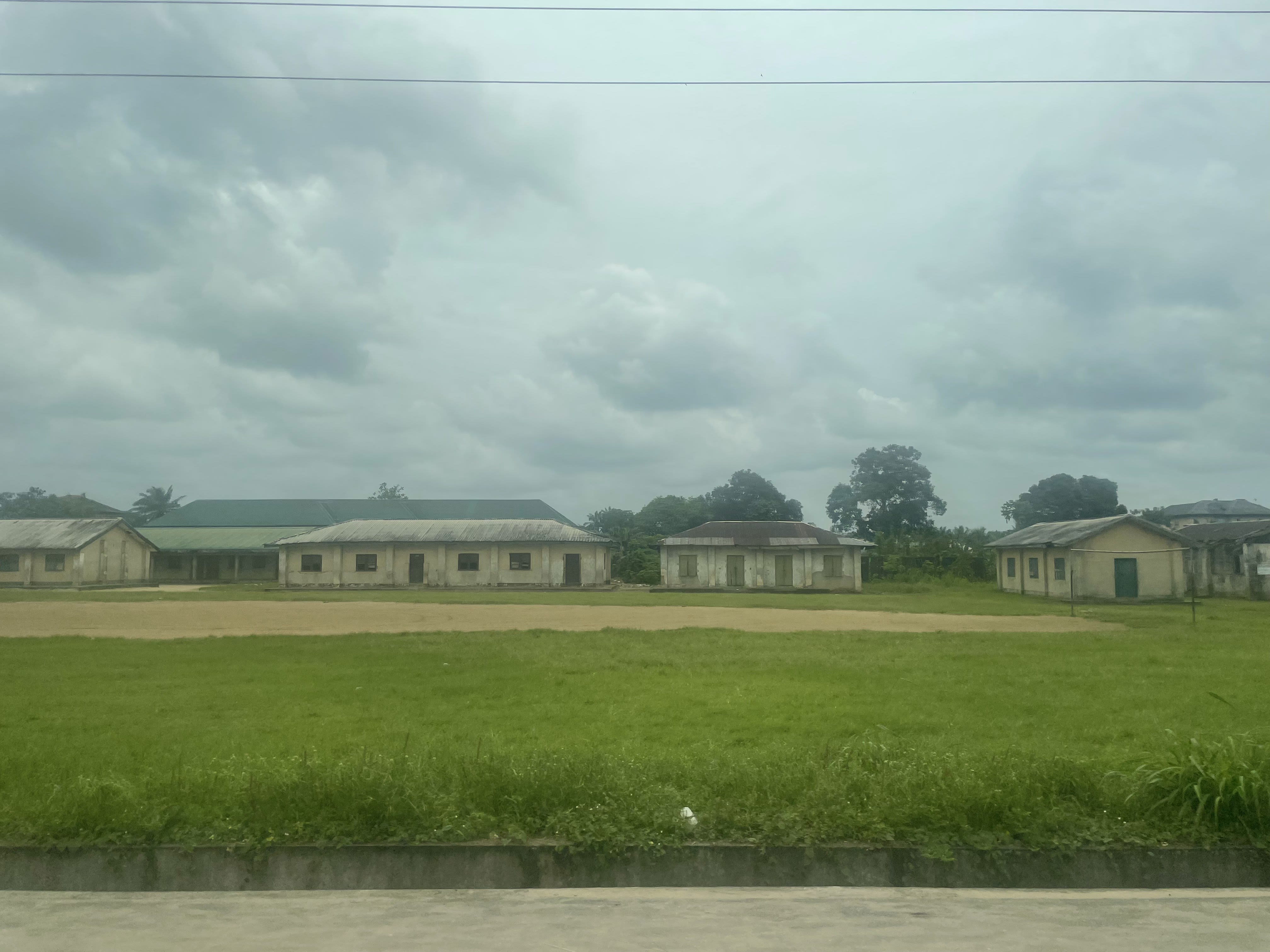
“I had to show them, ‘Here is my community,’” George says. “Wherever we went that I spent my life, I showed them. I said, ‘This is where I came from. This is what happened here when I was here.’”


Wow, Leesi thought. Y’all really came from nothing. Like when I say we’re village people, we are village people.
The infrastructure, the buildings, the air — everything seemed to be in rough shape. The nicest buildings were those belonging to the government, always heavily secured with gates and fences. Banks were minimal, and the easiest way to purchase goods was through a point-of-sale terminal, which charged extreme interest rates.
“Ogoni has not been healed in any way, shape, or form,” George says.
And yet, they ran into Monica’s father walking the streets of Baen, another Ogoni village, and posed for a picture with him. A woman who knew of their family ran up and inserted herself into another photo, excited to connect with them.


These people are also all Ogoni, Tombari kept thinking.
“We all had that in common, and there was a sense of pride like, ‘We’re all Ogoni,’” Tombari says. “Being able to feel part of something a little larger was great.”
“People make do,” Leesi says. “They’re just happy. I left with the sense that there’s a lot of community here. There’s a lot of love here. There’s a lot of support. There’s a lot of hustle and bustle. There’s more to life here than the perspective I came in with.”
On Leesi and Tombari’s last night in Nigeria, they were preparing to head to the airport. Their grandmother hadn’t really known them when they’d tried to interact with her. But then, right before they were about to leave, she remembered them. Suddenly, she knew who Leesi was, who Tombari was. She knew they were Monica’s sons. She began to pray for their protection as they traveled back to America.
“Ogoni always pray for the ability to move and pray for God to protect you as you’re doing so,” Leesi says.
A couple weeks later, his grandmother died.
“God really said, ‘You have one more mission prior to your passing,’” Leesi says, “‘to bless your children, to bless your family.’”
The girl he never expected
Brittney Cunningham was never supposed to fall for Leesi George-Komi. When they’d reconnected on a dating app in August, years after they were both undergrads at UGA, he’d made it very clear that he was only taking a semester off and going back to Ann Arbor in the winter.
Perfect, Brittney thought. This is just going to be a fall fling.
But by the end of September, when Leesi left for Nigeria, Brittney was concerned. They had similar values and priorities: God, family and friends, education, science. (She was in school to become a physician assistant.) He was genuine and kind, and his smile went all the way up to his eyes.
Oh no, she thought. I miss him. This is not good news.
“He conveyed the same,” Brittney says. “It wasn’t a fling anymore. At that point, I had already decided I was probably gonna pursue this. And then he came back from Nigeria, and that’s when he decided he wanted to die.”


This time, it wasn’t intentional. About a week after Leesi returned to America, fatigue, sweats, and gastrointestinal distress set in while he was at work; he was so sick that he couldn’t make it the hour and 10 minutes home. In the emergency room, he found out he had malaria. His kidneys were failing, to the point that he needed to start dialysis.
Brittney and Leesi weren’t officially a couple, but that thought didn’t cross Brittney’s mind. Despite working nine-hour clinical rotations and taking exams during the day, she spent evenings and nights at the hospital next to Leesi, urging his mom to go home and get some sleep in her actual bed instead of on the padded bench in the hospital room where Brittney herself tried to doze until her 6 a.m. alarm.


“Being able to be there for him was never like, ‘Oh, I’m gonna do this so you’ll ask me to be your girlfriend’ or ‘I’m gonna do this because I’m supposed to.’ I cared about him a lot. I wanted to be there for him,” Brittney says. “He made it, thank God, but it was a little touch and go for a minute. Both of us are very big on our faith, and in those times, all I could think was, ‘I don’t think that the Lord would give me this amazing man and then kill him.’”
When Leesi was working in the mail room at UGA, there was this girl he thought was cute, Brittney Cunningham. But he was so anxious that when he saw her coming through the window, he’d run and hide. (They talked about this later. She knew all along that he’d run away from her.)
A lot of life happened after that. Even so, when Leesi saw that Brittney had messaged him on a dating app so many years later, the nerves came back. He started pacing in his apartment.
Bro, I’ve been wanting to talk to this girl for a while, he thought. Forget it, I’m doing it, let’s go.
Knowing that he was only in Georgia for a few months — and that his recent relationship had ended, in part, because of his decision to continue pursuing his PhD— gave him the confidence to talk frankly about what he wanted out of dating. Brittney had just gotten out of a long-term relationship as well, so she felt similarly.
“That level of honesty opened up the ability to talk about more important things like religion very early,” Leesi says. “She was in school at the time — she’s one of the smartest people out there, I love her, she’s incredible — so we were able to bond on the importance of school. Seeing how she operated with her friends and her family was one of the things I truly, truly cherished about her, like the level of appreciation she talks about them and to them is something I love.”
“I was like, ‘I want what you have,’” Leesi says. “‘I want to be able to understand myself in the ways that you do. And I want to learn from you.’”
By the time Leesi traveled to Nigeria, he was smitten. He had no phone service on American networks, but he kept trying to find ways to talk to his girl. He and Tombari were sharing a Nigerian phone with internet access, and Leesi hogged it, DMing Brittney on Twitter whenever he had a spare minute.
“That caused some contention,” Leesi says, laughing.
Once he fell ill with malaria, he wasn’t lucid for a while. But when he became more alert and realized how much time Brittney had spent at the hospital, he was in awe.
“It was emblematic of exactly her core values and who she is and what she does for people she cares about,” he says. “It was like, ‘Wow, this is a level of love and appreciation in a person that I could only dream about.’ And even from there, we just continued to grow and get closer and closer. I’m not going nowhere without her. That’s my person. That’s genuinely the person that I believe the Lord has for me.”


They survived
It is dinner time in the George-Komi household.
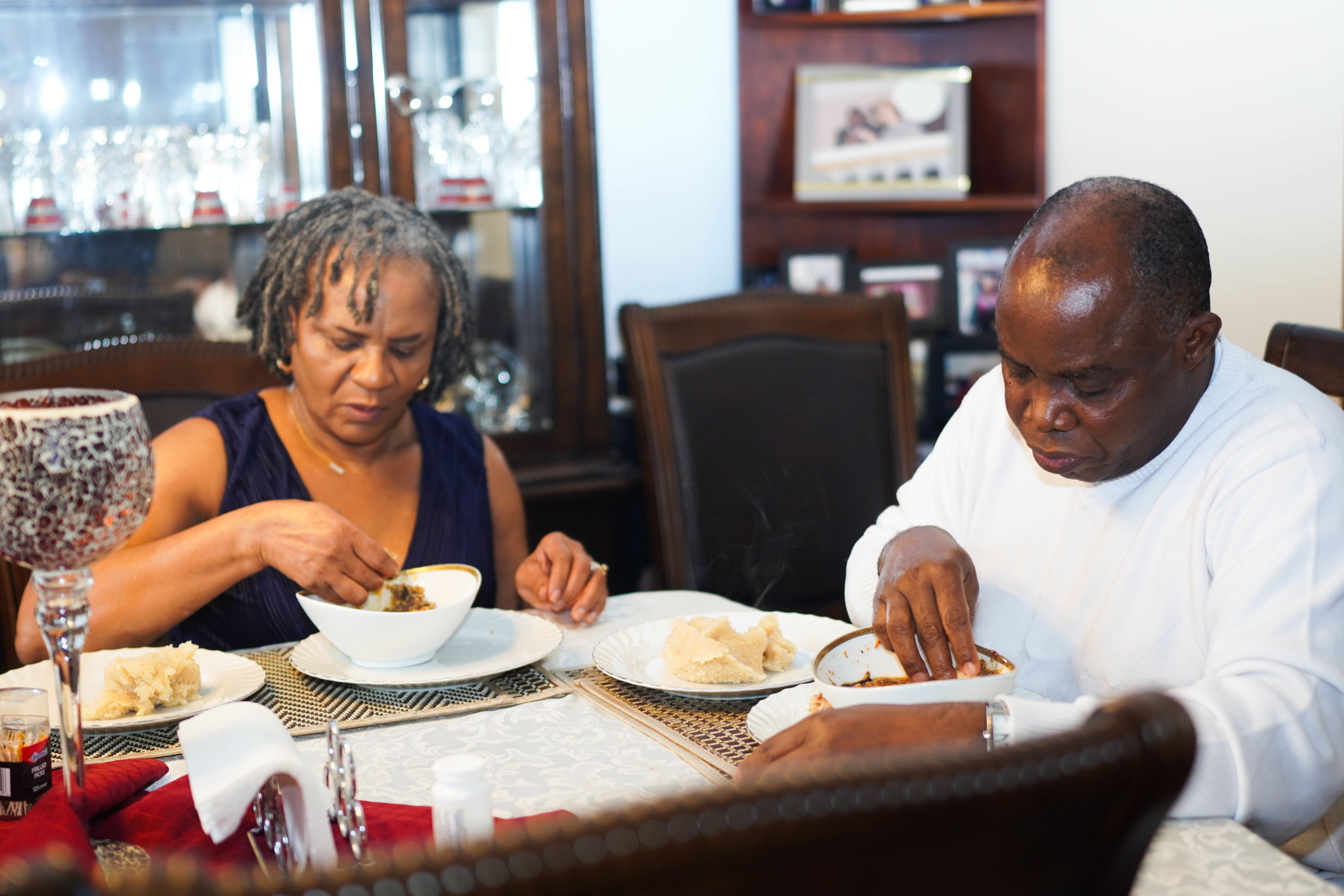
Monica and George are digging into bowls of okra soup, scooping out chunks of goat meat and smoked fish with balls of a spongy bread called garri, made from cassava like Monica’s parents used to grow.
Behind George is a photo of him and Mama Nancy. A picture on a lower shelf commemorates Monica’s graduation from her master’s program.
“Looking at this picture of them makes me feel like, ‘OK, we’ve come a long way, but we’re still true to who we are,’” Leesi says.


“As a kid, I was always like, ‘My parents are incredibly smart. They’re incredibly powerful to be able to go through these situations, just extremely strong,’” Leesi says, his eyes searching.
Now, looking back and realizing yes, there was strength. There is power. But in the doubt, in the down moment, they were able to lean on these protective factors like religion and community — and they leaned on them heavily.”
My parents have aged,” he continues, his voice cracking. “They both have grey hair. They’ve actually been able to grow and live a life where they’re not…I don’t want to say, we’re not struggling, but we’re not in a refugee camp. We’re not in that same position.
It makes me happy that they’ve been able to make it for so long.”
The research proposal
Leesi stands at the front of a conference room on the fourth floor of the U-M School of Kinesiology Building. All the seats are taken as U-M faculty, staff, and fellow PhD students crowd in to hear what Leesi has planned to propose for his dissertation research.
He comes off confident, fist bumping and hugging a few people as he gathers his notes. In reality, he’s sweating so much that the papers he’s holding become soggy. That’s particularly unfortunate because the digital notes he’d made in his presentation aren’t showing up so he has to consult his now-moist paper copies.
But he pulls it together. When he talked to his father recently, George had given him encouragement. As Ogoni, we have a foundation of strength and belief in God that allows us to instill firm self-belief in ourselves as well, George told Leesi. I was a leader in the Movement for the Survival of the Ogoni People! You, too, can fight!
“Good afternoon, everyone,” Leesi says. “Thank you for being here today. My name is Leesi, and I am presenting my dissertation proposal titled, 'Exploring the Role of Youth Sports in Mitigating Culturally Informed Adverse Childhood Experiences and Mental Distress: A Mixed-Methods Examination of Protective Factors.'”
“Mental distress, including anxiety and depression, is a growing concern among youth. Approximately 9.4 percent of youth ages 3-17 are diagnosed with anxiety. Twenty percent report at least one major depressive episode. Alarmingly, about 70 percent of adolescents with depressive symptoms develop full-spectrum anxiety or depressive disorders in adulthood.
“This brings us to a critical contributor to mental distress: adverse childhood experiences, or ACEs.
“Traditional ACEs include stressors like abuse, neglect, and household challenges such as substance abuse or incarceration. ACEs disrupt brain development, impair emotional regulation, and heighten the risk of mental health challenges like anxiety, depression, and suicidality.
“However, traditional ACE frameworks often overlook culturally specific stressors disproportionately affecting marginalized youth.
“Culturally Informed ACEs, or C-ACEs, expand the framework to include systemic stressors like racism, discrimination, and historical trauma. These unique stressors amplify traditional ACEs, leading to heightened risks of anxiety, depression, and PTSD.
“This highlights the urgent need for culturally responsive interventions to address these systemic stressors and foster resilience. One such intervention is sports participation, which offers structured environments to build supportive relationships, self-esteem, and emotional stability.”
Leesi talks about the ways that marginalized people protect themselves against mental distress, highlighting the importance of a strong ethnic-racial identity and supportive relationships with peers, siblings, and/or parents.
He mentions that several of these factors were highlighted in a 2023 paper by Enrique Neblett Jr., a professor at the U-M School of Public Health. But, he says, there hasn’t been very much research that looks at more than one of these factors in one study or that focuses on the lived experiences of the kids participating.
“Few studies have actually centered the children’s voices to understand their perspectives on sports,” he says, “and how sports can be used to buffer the impact of stress on their mental health.”


How the kids can be all right
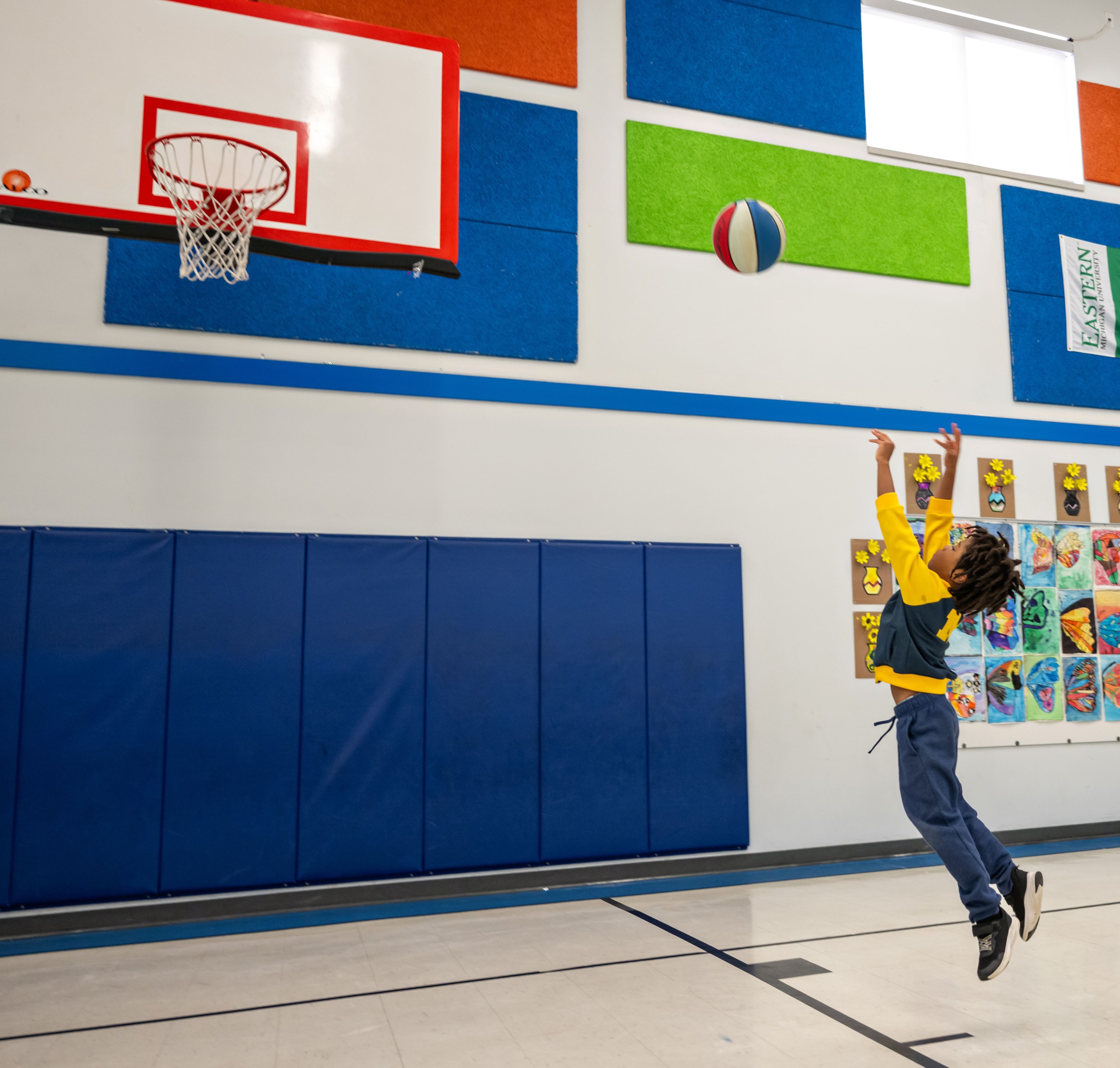
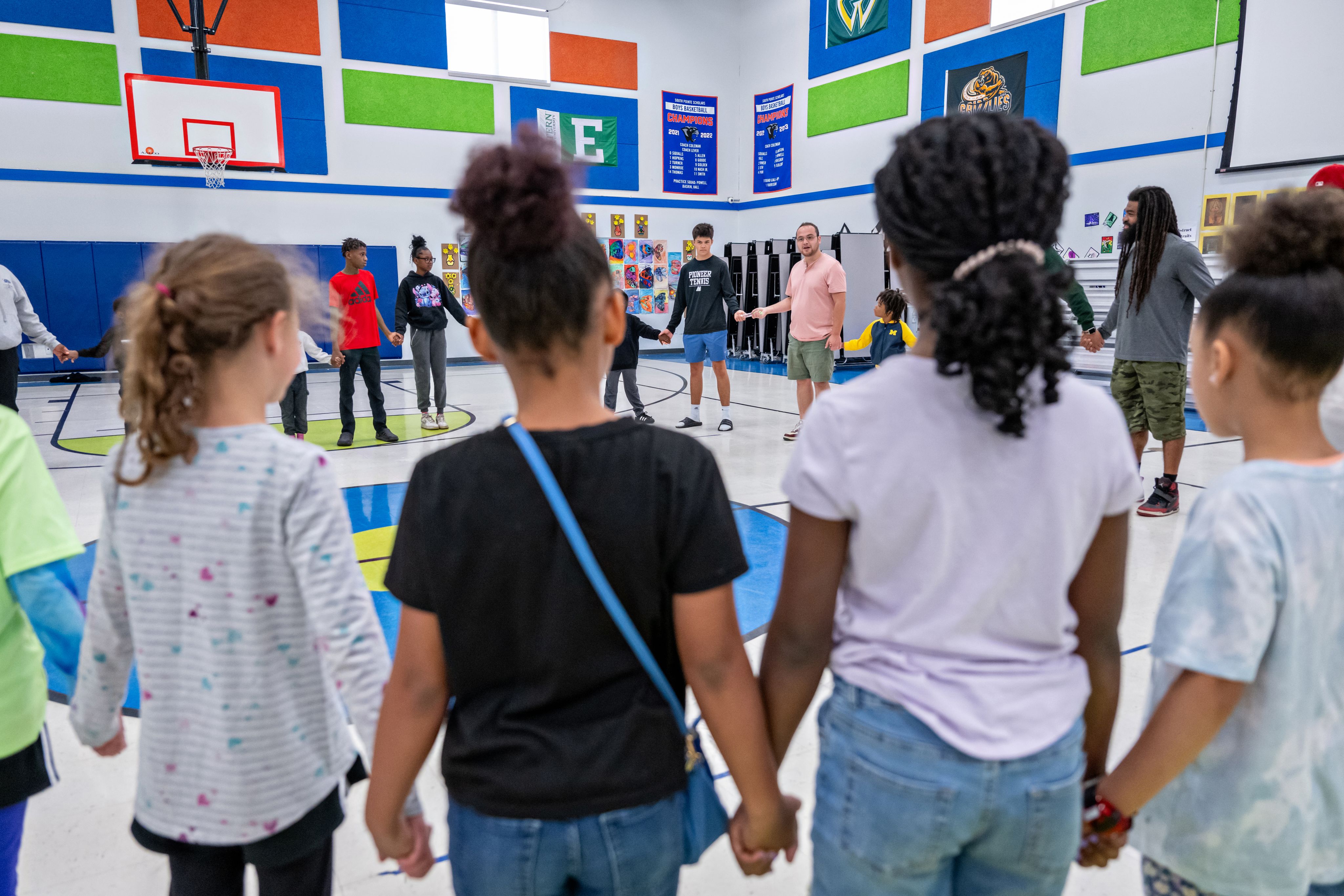
The walls in the gym at a school in Ypsilanti, are bright white, the color of a new whiteboard fresh out the plastic. Squares and rectangles of color — blue, red-orange, lime green — hang like flags toward the ceiling.
Children ages 5-14 dressed in sweats are shooting basketballs toward the hoops at either end of the gym and chucking Nerf footballs at each other. Other kids are sitting at a cafeteria table at the side, drawing with markers and colored pencils or creating art out of neon pipe cleaners.
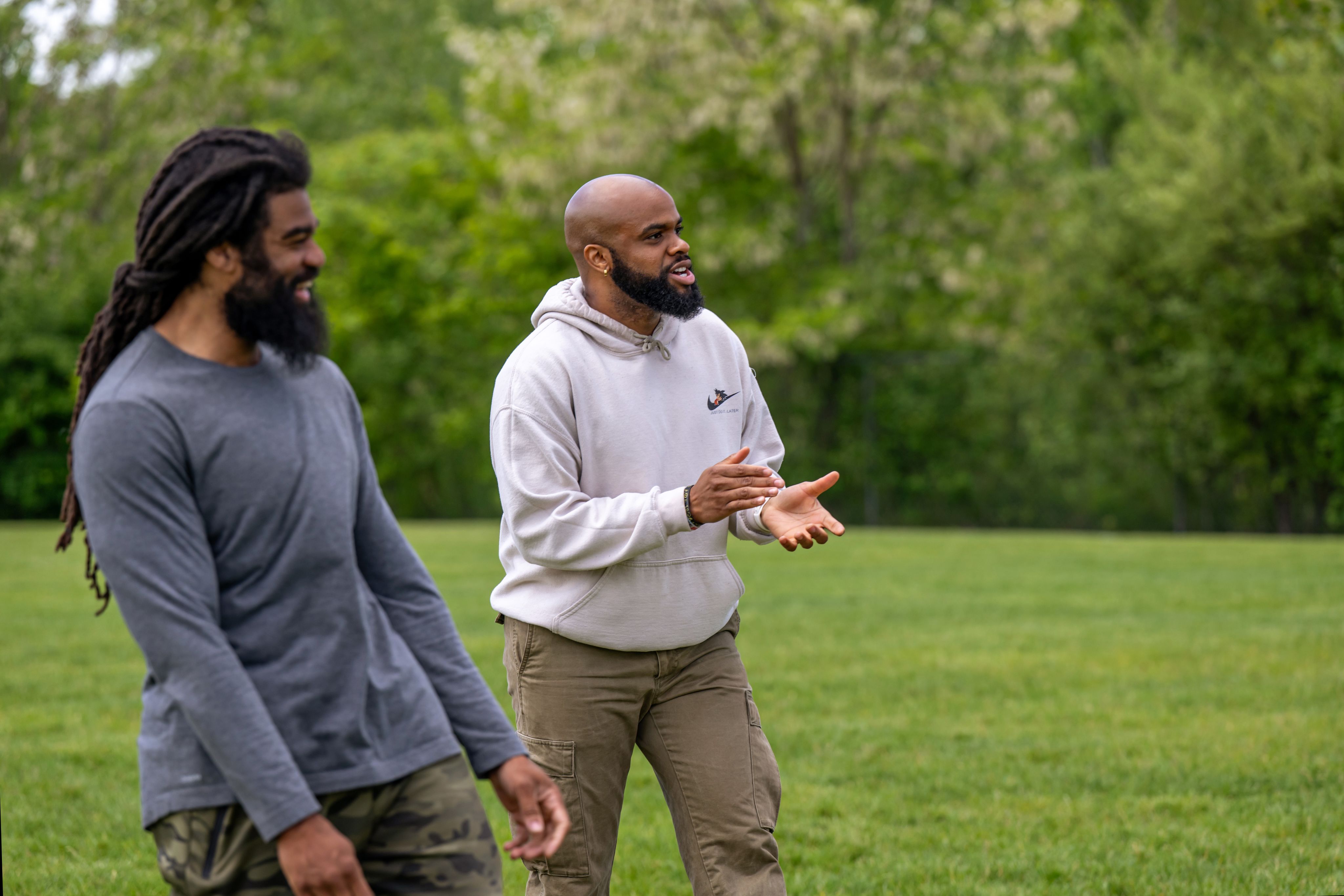
Parents and guardians are bringing more children through the door into the gym. They’re greeted by Justin Harper, a bald man with a scraggly beard whose eyes light up when he talks to kids.


Next to chat with them is often Leesi, who hands them a flyer with the title, “Wondering if youth sports helps decrease diabetes risk?” and tells them about the study he’s conducting.


As part of his dissertation, Leesi has secured a grant through the American Diabetes Association to examine whether physical activity decreases risk factors for diabetes, which include obesity as well as anxiety and depression. Here at CLR Academy (CLR), a youth academy in Ypsilanti that primarily focuses on giving minority students within the community a place to be active, he’s looking at whether CLR participants improve in any of those risk factors and how many sessions are needed to have an effect.
He’ll weigh the kids, measure their height and waist size, and calculate their levels of anxiety and depression at the beginning and end of the program, but he’ll also interview coaches and students to figure out: What about CLR helps and what doesn’t?


The additional funding has helped CLR run programs, like this one at South Pointe Scholars, during the school year instead of just the summer for the first time.
“All right, huddle up,” says Justin Green, a CLR coach, and all the children and a few adults form a large circle.
“Good morning to everybody,” Green says. He holds up a sign with red, green, and black stripes running across the top and the bottom. In the middle sits a crest with a raised black fist and the words “CLR Academy” above it.
“What does the ‘C’ in CLR stand for?” he asks. A child raises her hand.
“Community,” she says.
“Community,” Green affirms. “Everyone say ‘community’ on three.”
“Community!” everyone yells.
He repeats the process with the “L” (Leadership) and the “R” (Revolution) in “CLR” and then goes through the rules outlined on his sign: 1) One rapper. One mic. 2) Don’t hate. 3) Circle of trust. 4) Respect. 5) Have fun!

The kids are squirming, ready to get into the day’s activities. But he asks them to wait as he poses the day’s question: “What is stress?”
Another kid raises his hand.
“Where you’re going under a lot of pressure,” he says.
“Yes,” Green nods in affirmation. “Now we’re going to split up into two groups and talk more about that.”
The kids form two smaller circles, separating naturally into age brackets, each with two adult coaches. Everyone says their name, most in whispers that are difficult to hear. A coach asks what situations might cause stress, and the answers become a little louder: tests, tryouts.
By the time the conversation turns to ways to cope with stress, the older kids’ voices have become more confident.
“Take deep breaths,” one says.
“ASMR videos,” another pipes up.
“Fidgets,” a third offers. “I have stress problems sometimes, and my teacher gives me fidgets.”
The children then scatter for warm-ups — lunges, high knees, butt kicks. Leesi shouts out praise to one child, who’d kept to himself in past sessions but is now hanging with some other kids.
“Something I try to remind him is that although the age group he's looking at is not his own, that he is a part of his research,” says Brittney, Leesi’s partner. “Being able to incorporate his own experiences into it and remembering how he felt at those ages makes it so that it’s not just about the numbers here, the numbers there. But then I’m also reminding him of the flip side: That now you're an adult, and you have a better handle on a lot of the social components that you could not yet understand as a child or you didn't even know existed yet. It’s a tale of both heads.”
The CLR kids go into drills, tossing a basketball back and forth to each other at different heights and then adding a lay-up at the end.
“Wow, that’s incredible,” Leesi says, watching them throw the ball. “From a biomechanics perspective, the way he threw that was kinda difficult!”
There’s screaming and shouting and errant balls flying everywhere as the kids skip around. Some kids are back at the arts and crafts table, but no one is standing off to the side watching; everyone is participating in some way.
One child shows off her pipe cleaner creation, with different colors twisting over, around, and under each other. When asked if her art has a name, she says no. But after further thought, she says, “I think it’s called ‘Colorful.’”
After the session, Leesi sits in a classroom with Harper, brainstorming about additional ways to bring in funding for CLR. He has some ideas, including an internship position he’s trying to land for the summer.
“How can we create a space for our youth to thrive in an environment where we’re not getting funding at the county level to support this type of thing?” Leesi wonders.





Section V: Discussion
Leesi and his parents reflect and consider what they can glean from the past to improve the future.


Final thoughts (parents)
Monica and George sit in their home in Stone Mountain, Georgia, on a Zoom call with a writer in Ann Arbor, Michigan. They talk about how Ogoni used to be a food basket, how their land and their autonomy and their health was gradually taken away from them.
“This had always been our pride, our environment,” George says. “We told them, ‘Don’t destroy it because when you do and you walk away, we will have nothing left for our kids. For ourselves and our kids.’ But we were the minority, so we were dispensable. Disposable, like a syringe.”
When they tell the story of meeting covertly to conceive Leesi, they can barely get through it because they’re laughing so hard. They manage by trading off telling different parts, tapping each other on the arm and asking each other, “Do you remember?”
Their faces glow rosy when they talk of becoming American citizens. Monica sings the line “I’m proud to be an American,” pretending to conduct an imaginary crowd and immediately cracking up.

They are still proud to be Americans, they say, but the American — and global — environment has changed since they arrived.
“When I see similar things to what has happened in Nigeria, it makes me see that this is a global problem,” Monica says. “It’s not just peculiar to Nigeria. This inequality, be it between men and women or between a bigger population and a smaller population, between colors and between children, it’s all over. That’s what I see. And I see that this global problem starts with individuals.”
“What I’ve been doing myself is to see what I can do to be different from that. Being the president of the Ogoni Women Association of Georgia, I’ve been actively working to make sure that we treat one another the same, with respect. Not all of us have the same educational background, but we still work together.
“We talk about it in our meetings, to be more open to other people, even though sometimes you’re scared of being open. We venture out there to have fun together with other people, bringing our food to other people to share with them. Because it is when you travel that you know that the things that are happening in your own little community are also happening in the bigger community and from the small countries to the bigger countries,” she concludes. “We have to do our part to minimize the inequality because other countries look up to America.”
“That was a time when people felt the pain of the other person,” George says of 1996. “I’ve been thinking: If what happened to us had happened now, probably I’d be dead. My entire family would be gone.”
“I’m indebted to this country because today I have three boys. I have a son who, God willing, in the next couple of years will have a PhD. I have a wife who has a master’s degree. My second son has a degree and is working. I have a son who just graduated this year.
“We had a church that took us as their own. I lost my father at 19 before I came to this country, but I had somebody, Uncle Sam, who played the role of a father to me. I ran away from home, leaving my mother behind, but I came to this country, and I had somebody, Mama Nancy, who played the role of a mother. These were people who were role models to me and my family, people who held our hands to get us to where we are today.
“Who would do that today? In the short time I’ve been here, I’ve seen so much evolution in policies, in actions, in rhetorics, and in people’s compassion. Yes, in people’s compassion and care about our common humanity.
“I pray it’s just a phase,” he finishes. “Otherwise I’m scared for what’s coming.”


Final thoughts (Leesi)
Leesi sits across the table from a writer in the School of Kinesiology Building in Ann Arbor, Michigan. The two of them have met more than 10 times over the course of a year and a half, reliving the lives of Leesi and his parents in sessions that last hours.
“I always want my story to make sense,” Leesi says. “But I’ve thought about: Who do I think is cultivating that idea of sense? Is it me? Is it society? Is it my parents, my friends, my siblings? Who am I trying to make sense to? Why? And is that sense beneficial, is that sense aligned with the purpose that God has intended for me and what I can actually do in this world?”
“If it doesn't, then that's not sensical,” he continues. “That's just a parameter that I placed upon myself that diminishes my mental health at times and limits my ability to be able to act in ways that are important.”
“If my work can help show how something like playing sports can strengthen a person’s sense of self and their connections with others — building the kinds of relationships and identities that protect mental health, especially in the face of stressful life events — then maybe that’s one way I can contribute to making sense of it all,” he says. “Not just for me but for all of us in the society at large.”
He mentions a quote by Martin Luther King Jr., who once said, “The arc of the moral universe is long, but it bends toward justice.”
Leesi disagrees.
“I think that we bend it,” he says, referencing author Ta-Nehisi Coates’ book Between the World and Me, in which Coates states that the arc is actually “bent toward chaos.” “Justice doesn't just happen. Right things don't just occur. That's not how history starts. That's not how movement starts. Movement rarely starts with just one individual. That individual is inspired by somebody else and that individual is inspired by somebody else and so on. People take small initiatives to be able to bend the arc.”


Keeping the story going
Another photo was taken the same day as the one of Leesi’s parents eating okra soup.
In it, Leesi is sitting on the floor in front of the dining room table, surrounded by three blue suitcases that hold his family’s memories.
“I am the one that kept the suitcases,” Monica says.
I did that because that is who I am. I like history. I like to keep history.”
She turns to look at George.
“And of course, my husband is a historian.”


“Pictures and objects tell a lot of stories,” she continues. “They’re a good way to tell your life story: ‘This is how I came all the way to where I am.’ I have my baby picture with me. I have my mother’s Bible with me. I still have this wrapper.”
She gestures to the blanket she’d used to hold Leesi close as she ran covertly across the Nigerian border 29 years ago.
“So I like to keep stuff. And Mama Nancy likes to take pictures of us. And when she prints the pictures, she will not print one copy — she’ll print several copies.
“So in those suitcases, each of the kids have their own album. I’m waiting until they get married so that I can just hand them their luggage and say, This is yours. Whatever you want to do with your pictures, your history, that is up to you.”
“We don’t want the story to end with us,” she says, “or with them.”


 Built with Shorthand